Operations Center
Gives leaders a current operating picture and the tools to set priorities, manage tasks, oversee resources, and follow execution across the operation.

The OnSeen platform
OnSeen’s agentic Resource Allocation AI determines what changing conditions mean for the operation, develops alternative responses, and tests whether available resources can carry them out. It autonomously allocates People, Places, Things, Time and Money, puts the resulting work into motion, and keeps adapting as execution reveals what needs to change next.
Understand
the operation.
Determine
what happens next.
Put the response
into motion.
Operational outcomes inform
the next cycle.
From allocation to execution
OnSeen’s agentic Resource Allocation AI sits at the center of the platform. It reasons across objectives, priorities, constraints, and available resources, then autonomously prioritizes, tasks, schedules, dispatches, routes, and monitors the work.
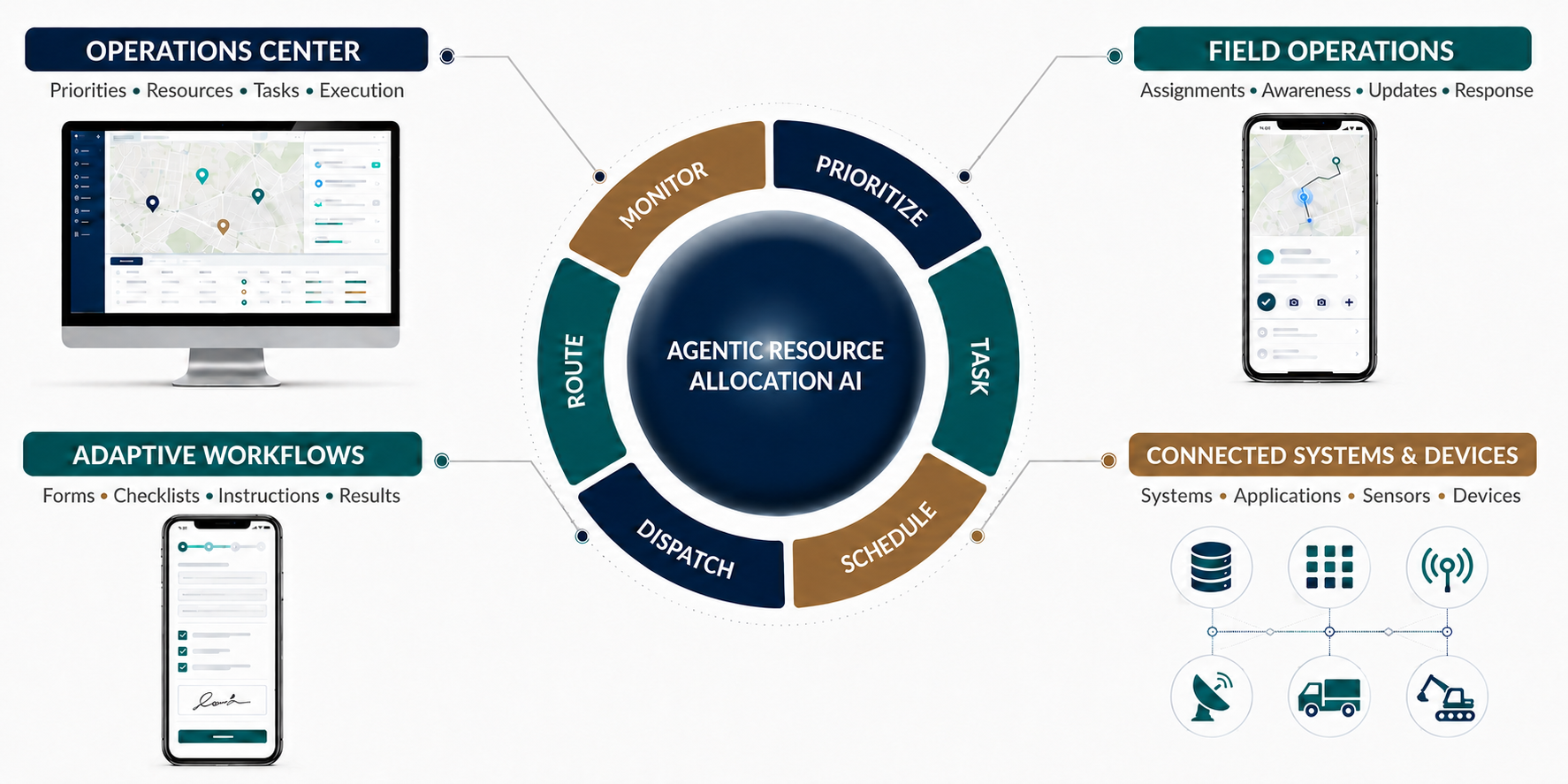
Gives leaders a current operating picture and the tools to set priorities, manage tasks, oversee resources, and follow execution across the operation.
Autonomously delivers assignments, situational awareness, updates, and response tools to the people carrying out the work. Field teams submit completed checklists, work status, and location updates, giving OnSeen AI the feedback to reassess resource allocation and adapt ongoing work.
Generates task-specific forms, checklists, and instructions around the responder’s role, location, applicable procedures, and current conditions. These guide the work and capture results as it is completed.
AI agents invoke capabilities in connected systems, send tasking, and receive execution results. Information from systems, sensors, communications, and operational devices keeps the response aligned with changing conditions.
From objective to executable work
An objective becomes a set of dependent tasks. OnSeen determines which resources each task requires, what must happen first, and where competing demands create conflicts. It tests alternative responses against those conditions and develops another approach when one fails. The resulting allocation connects the objective to work the organization can actually perform.
Inside OnSeen’s Agentic AI
OnSeen’s Resource Allocation Engine connects three capabilities to turn organizational knowledge into executable plans.
Institutional and operational memory
Connects organizational facts, requirements, plans, and decisions to the people, places, and assets they describe. Current conditions, working memory, and durable knowledge remain distinct, with sources preserved.
Spatial consequence
Maps operational value, vulnerability, and dependencies across the organization and surrounding community. OnSeen AI uses that spatial context to determine how an incident or asset failure affects the wider operation.
Executable planning
Breaks complex objectives into dependent tasks, develops competing plans, and tests resource, time, and policy constraints. When an approach fails, it develops another path or identifies the need for human intervention.
Five resources. One operation.
Most systems manage these resources separately. OnSeen treats them as one interconnected allocation. It reasons across the tradeoffs, determines how a change in one affects the others, and autonomously reallocates them around the operation’s current priorities.
Allocate personnel based on skills, roles, availability, location, and current operational priorities.
Account for facilities, sites, routes, operating areas, access, and geographic dependencies.
Assign equipment, vehicles, supplies, sensors, and other operational assets to the work.
Reconcile urgency, duration, sequence, deadlines, and competing demands across the operation.
Balance budgets, costs, funding limits, and financial priorities against operational requirements.
One platform. Two operating environments.

Adaptive autonomy for defense operations
Dominion is the Resource Allocation Engine inside I2MS, OnSeen’s command, control, and execution platform for defense missions, installations, and operational environments.
Dominion autonomously allocates resources across military operations, adapting as mission priorities and conditions change.

Adaptive autonomy for civilian operations
Harbinger applies the same agentic Resource Allocation AI to public agencies, infrastructure operators, enterprises, home healthcare, and distributed field organizations.
Harbinger autonomously allocates resources across civilian operations, adapting as operational priorities and conditions change.
Put Resource Allocation AI to work
Show us the objectives, priorities, constraints, systems, and available resources that shape the operation. We will show you how OnSeen autonomously determines a feasible allocation, puts the resulting work into motion, and adapts as conditions change.
Request a briefing